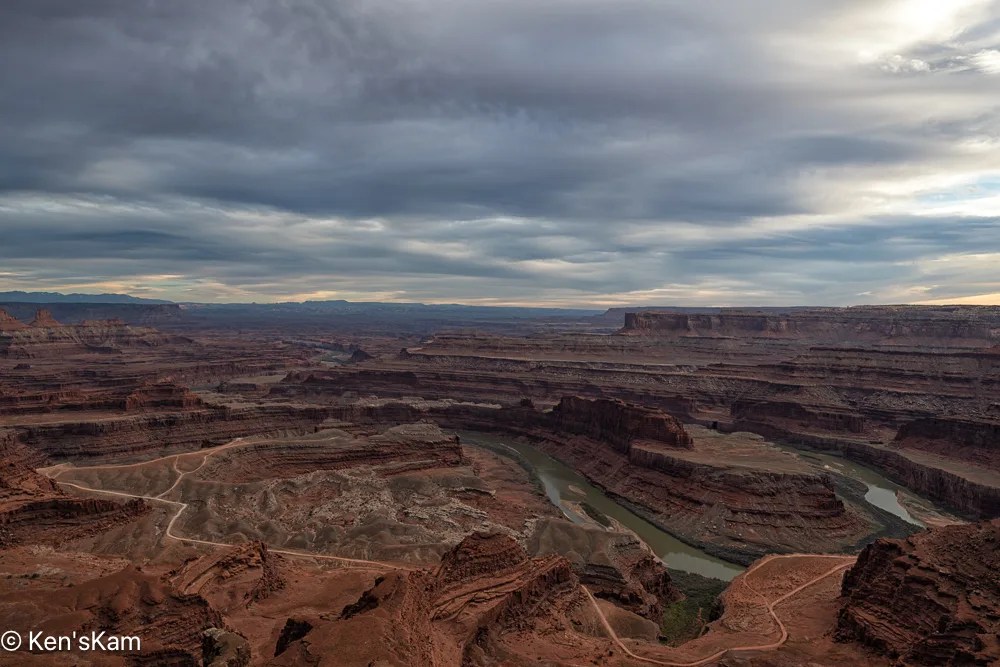
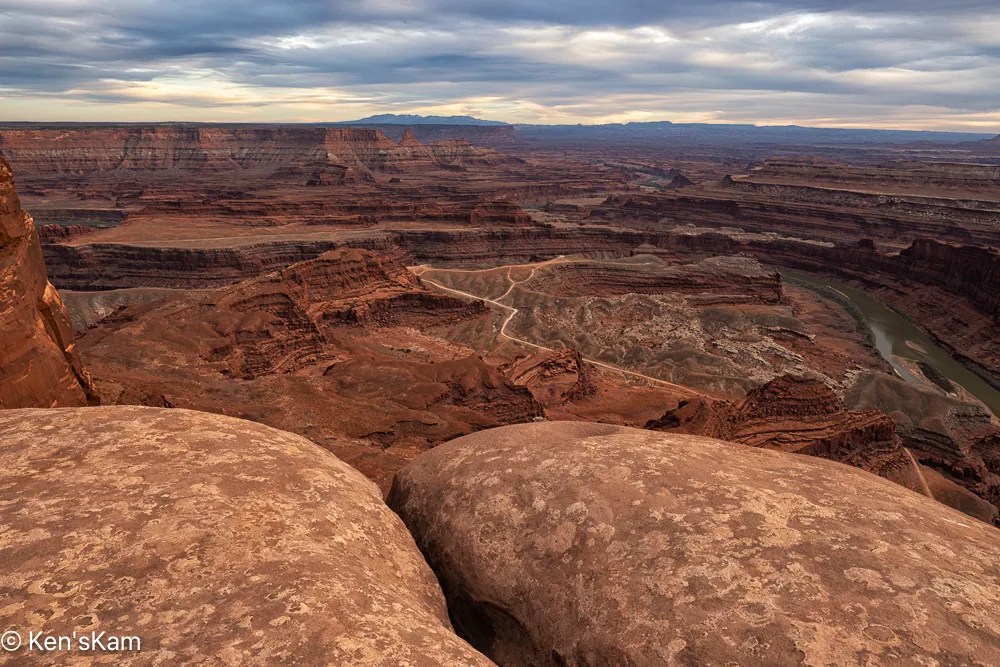
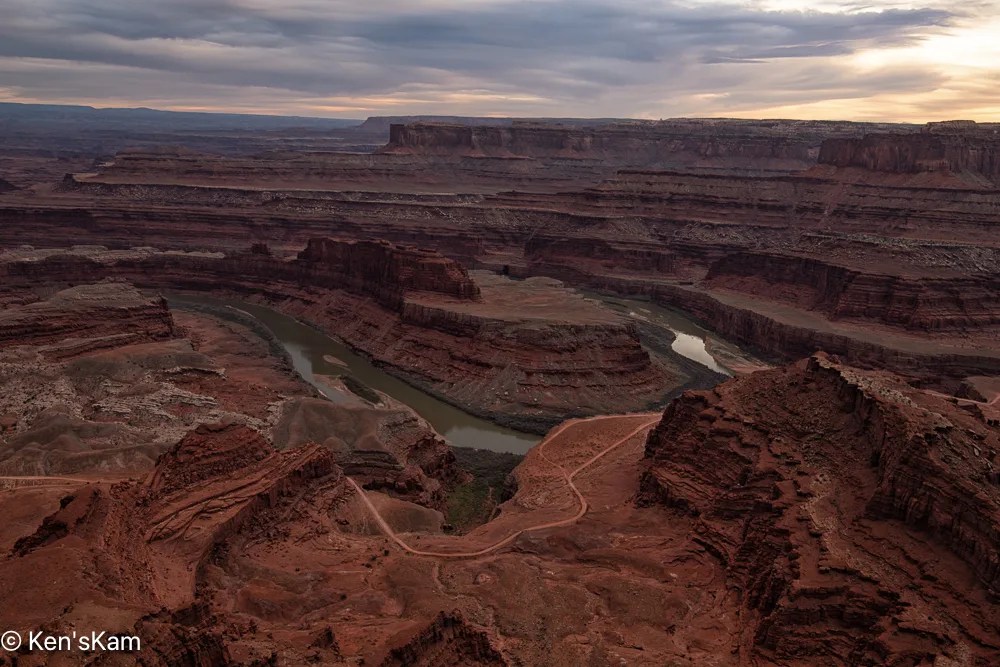
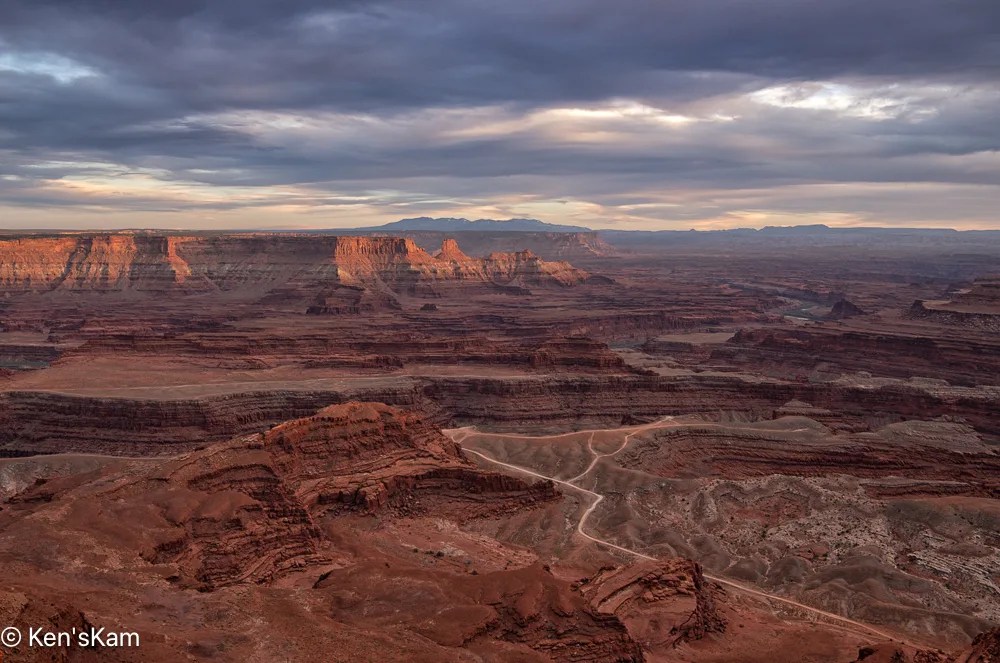
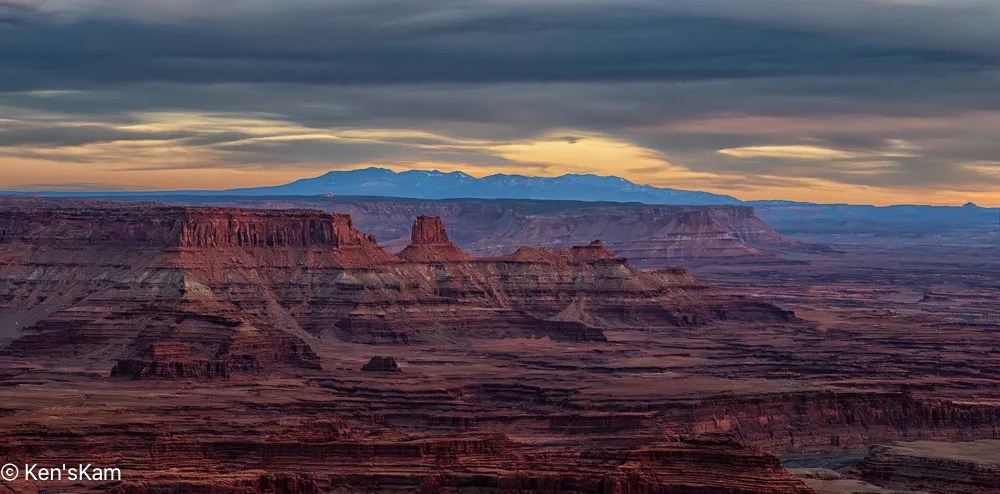
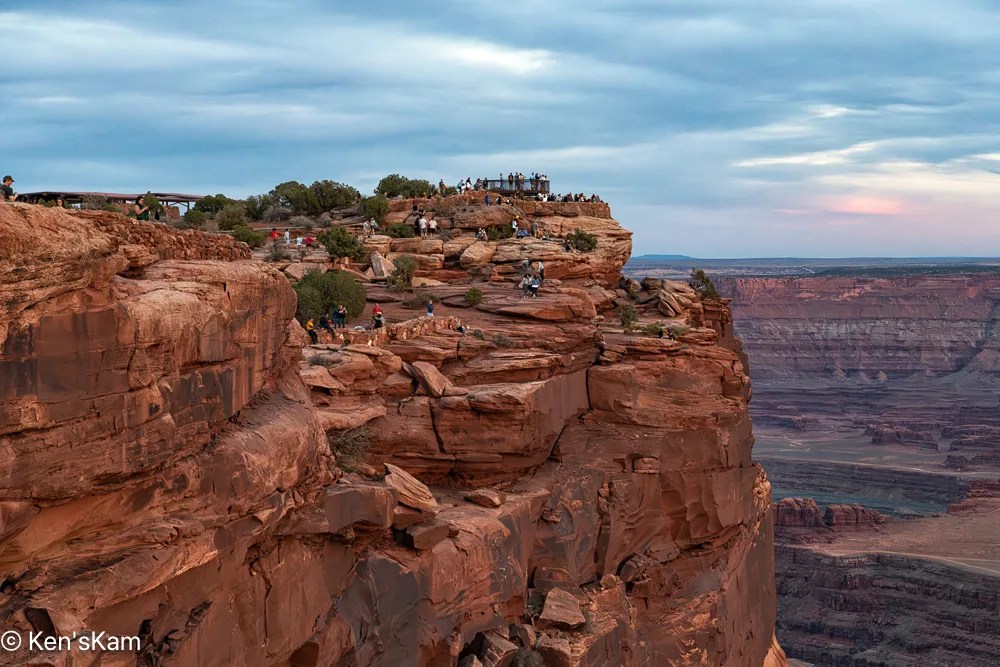
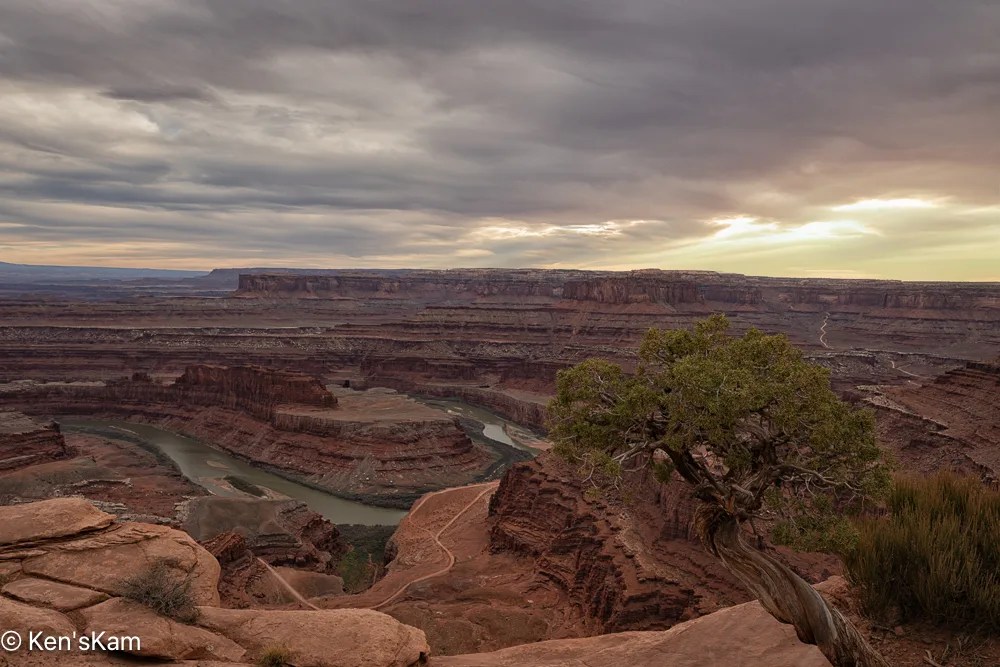
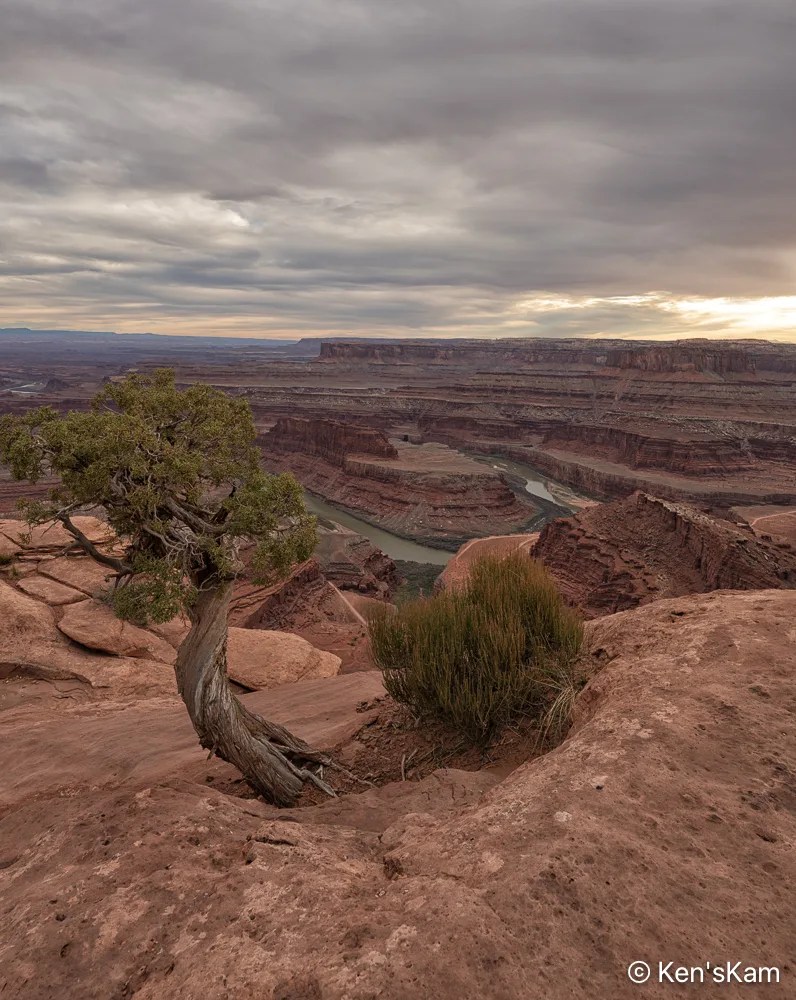
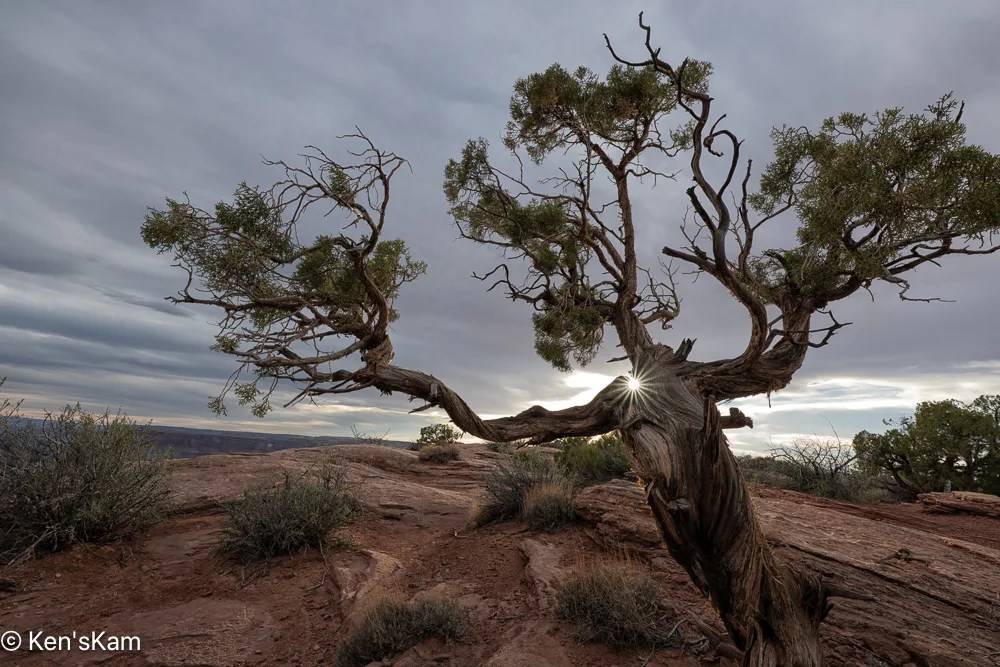
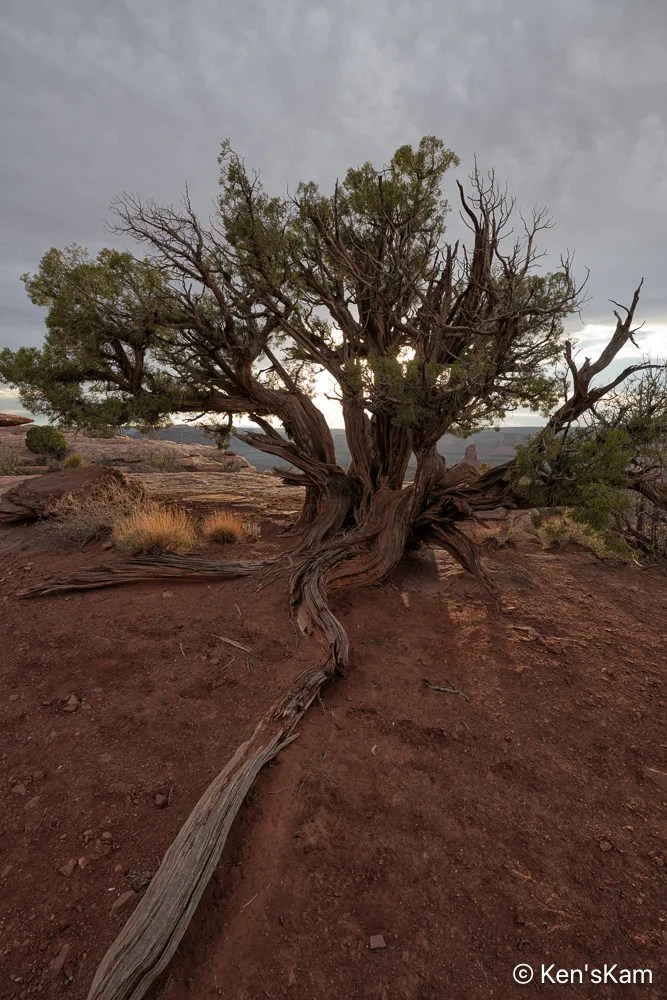
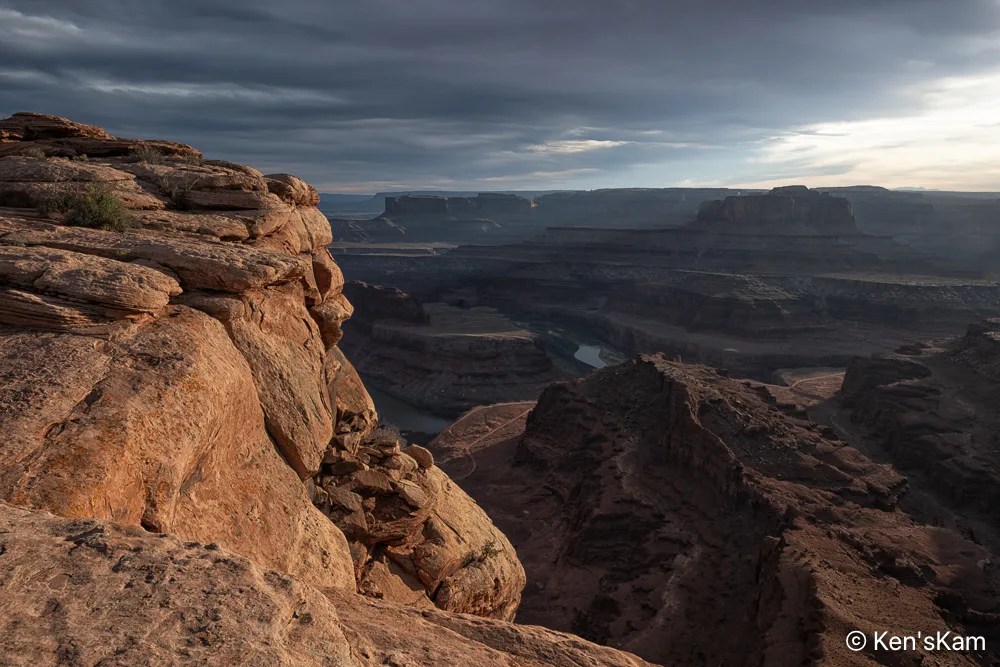
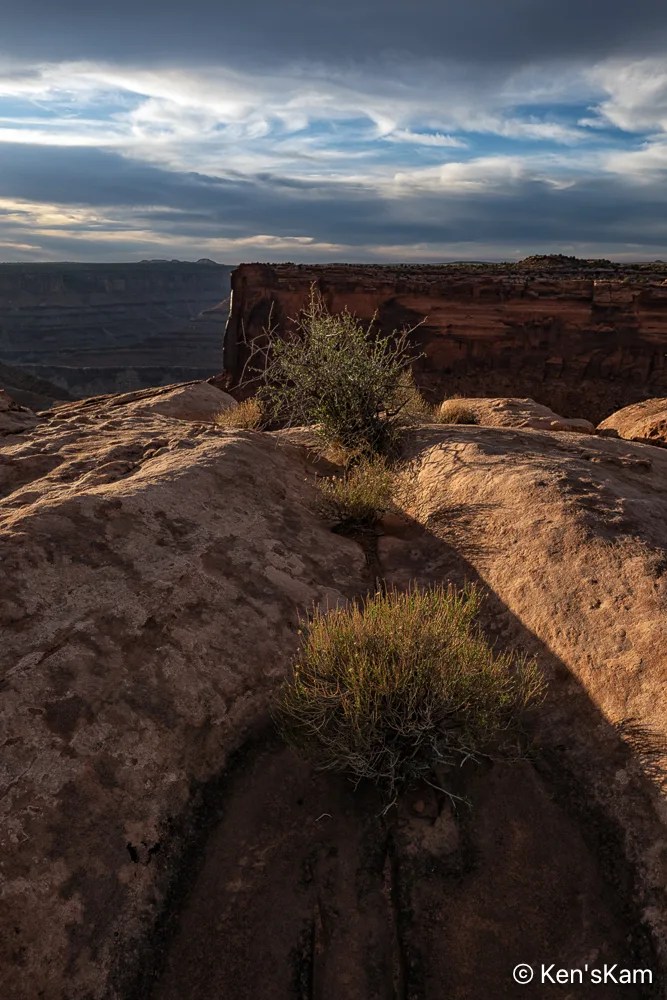
After driving Potash Road and the Shafer Trail, we returned to Dead Horse Point for sunset photography. It was a heavily overcast evening, so prospects for a golden sunset hour did not look promising.
Desert plants sink their roots into the thin soil and hard rock, where scant moisture hides from the harsh sun. The V shape of the niche in the rock is reminiscent of similar shapes seen in Georgia O’Keefe’s artwork.
Followers probably noted the winding road through the landscape as seen from Dead Horse Point in previously posted images. After shooting sunrise at Dead Horse Point, we traveled that road. This post contains a few of the photographys made along that road.
I think this road might be refered to by different names and I’ve mostly heard folks talk about this route as Shafer Trail, but my map shows this portion as Potash Road, to the best that I can decipher the map labels
This pond is a part of a potash production facility. Potash (potasium chloride) is disolved from underground rock with water pumped from the Colorado River and put into evaporation ponds. Blue dye is added to the water to increase solar energy absorption that heats the water speeding up the evaporation process. These ponds can be seen from the Dead Horse Point overlook and are in some of my photos made at that overlook.
The road we traveled changes its name to Shafer Trail somewhere along the route, I think at the point where it enters Canyonland National Park. This photo was made at an overlook near where Shafer Trail exits onto a paved road near Canyonlands NP Visitors Center.
I’ve fallen behind in my normal blog post schedule, being preoccupied with other summer time activities. I’ll try to get back to a more regular schedule.
Sunrise Golden Hour 1
I used this geological feature as a foreground for star photography. As usual, I’m slow at processing those night images, so the star photos will have to be in a later post.
As we drove back along the route we had taken to get to Utah’s Little Grand Canyon, we stopped to check out a side road near a large campground, where we were considering staying; but as we explored the side road, we discovered more interesting scenery and plenty of open campsites at which to enjoy the scenery.
Our Campsite off of Mexican Mountain Road, Utah
Look closely and my Sportsmobile can be spotted near the center of this image. If just glancing at the image, the Sportsmobile might be mistaken for a natural feature.
This pano, made from our campsite, is of geological features across the roadway.
Across the Roadway 2Across the Roadway 3Near Sunset
We will shoot star photographs at this location. These images were taken not only to show the local scenery, but to select compositions for night sky foregrounds.
More local images and exploration images to follow,
When shooting at golden hour, it is rewarding to look around and towards the western sky, as the setting sun often creates wonderful colors in clouds, which might go unnoticed if one focuses too much on the eastern sky.
After sunset, we set our cameras up to shoot the night sky. As usual, I’m slow in processing those many, many images. So I’ll have to postpone the night sky blog and move onto sunrise images in the next post.
That bush skeleton was mostly in shadow before golden hour, so only a tiny portion of it is illuminated and the same is true for the tree skeleton in the image below.
My son and I began shooting at Utah’s “Little Grand Canyon” ahead of sunset golden hour. This post contains images from that portion of time. The next post will contain golden hour photos.
I like the way the late day light highlights the grass growing in the cracks between the rocks in ‘Late Day Shadows 4’, but I like the bigger picture image ‘Late Day Shadows 5’, made just a little later, when the highlights were almost gone, more. That small tree and the grass anchor the image in ‘Late Day Shadows 4’,
Late Day Shadows 5
but somehow getting more of the rocks into the foreground appeals more to me.
Note that ‘Late Day Shadows 6’ is composed very much like ‘Late Day Shadows 3’, but the shadows are deeper and the highlights look a little brighter in contrast to the shadows. Golden hour is close now. Stay tuned for golden hour images,
An early rancher in this area left his name on much of the area and there is an old log cabin that he built alongside one of the easily traveled roadways that any vehicle can travel to, at least in good weather. However, just past the cabin that roadway becomes a “moderate” 4 wheel drive as rated by trail books, but has some intervals of what might be better be described as “difficult” 4 wheel drive sections, which we decided not to venture very far along.
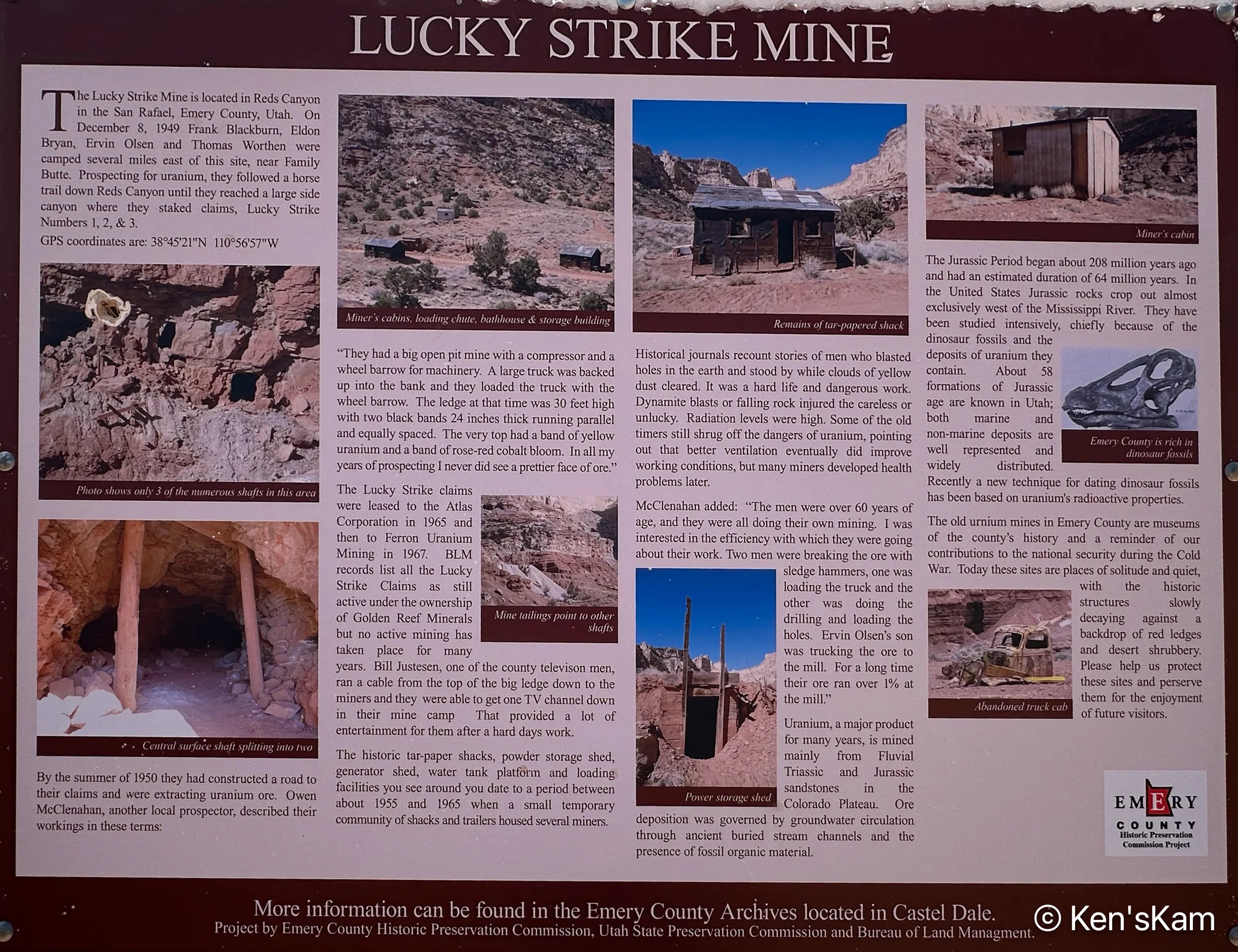
This old shack is at an abandoned uranium mine site called the Luck Strike Mine, which is actually still classified as “active”, even though there has been no activity here for many years. The small structure on the right of this image is a powder (explosive) storage shed.
This sign near the shack give a brief and interesting history of the mine and the lives of the miners who worked the mine, many of whom developed illnesses related to radiation exposure before there were any significant safety regulations regarding such activity.
Most of the photos in this post were made via an iPhone camera.