Utah – March 2026 – Part 8

In reviewing a map of the area near our base camp, we discovered a place referred to as Utah’s “Little Grand Canyon”, along the San Rafael River. So we set out to check out that site. Along the way we found other interesting places and sites. This post and following ones will showcase our finds.

The drive to the “Little Grand Canyon” was along maintained gravel backroads, although most of the roadways were washboarded, rocky and rough, but scenic for long stretches with exposed geological features.

There are a couple of easily accessible Native American artwork panels on rock faces along this drive. One requires walking up a slight incline to reach, but the most impressive one, Buckhorn Wash Petroglyph Panel, has a large parking lot and is literally right at the edge of the parking lot.

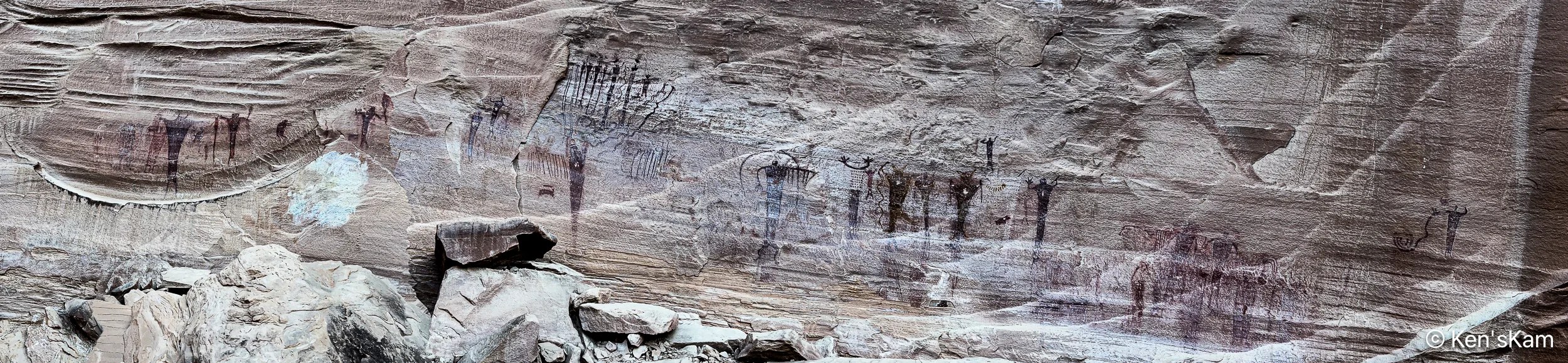
Buckhorn Wash Petroglyph Panel Pano

The Buckhorn Wash Petroglyph panel is long. Much longer than this panorama might indicate. I made this panorama with my iPhone by walking fast from one end of the panel to the other, trying not to trip and fall on the rocky, uneven surface. I was inspired to do this, after watching my son do it. Otherwise, I might never have thought to do a pano in this manner.

The following images are shots of small portions of the panel, showing details of some of the pictographs.

Buckhorn Wash Pictograph 1
Buckhorn Wash Pictograph 2
Buckhorn Wash Pictograph 3
Buckhorn Wash Pictograph 4
Buckhorn Wash Pictograph 5
Buckhorn Wash Pictograph 6
Buckhorn Wash Pictograph 7

There are a number of signs placed in front of this panel with information and questions about what these images mean and how newer cultures came along and modified the older pictographs. And, yes, even modern day vandalism. In fact much damage to this panel was partially repaired in 1995.

Information Sign at Buckhorn Wash Petroglyph Panel

Please refrain from defacing such ancient records. These are already fading away due to natural weathering. Don’t accelerate the loss.

Ken

Utah – March 2026 – Part 7

From our base camp, we made a number of drives along 4 wheel drive roadways, portions of which were easy, some of which were “moderate”, involving driving in washes, alongside cliffs, drop offs and over boulders.

One of the these 4 wheel trails is called “Black Dragon”. We started this drive from our base camp and exited between portions of the San Rafael Reef onto I70. The Black Dragon names comes from a Native American Pictograph, which this trail goes past near the I-70 exit/entrance.

Panorama at Black Dragon Viewpoint

This panorama was shot from Black Dragon Viewpoint along I-70. A portion of Black Dragon trail is visible (a narrow band of light color) at the base (approximately in the center of the image) of the geological feature in the distance.

Black Dragon

Note the chalk outlines added by someone, joining several pictographs to make them take on the appearance of a dragon. This is a defacement of the original Native American artwork.

The pictographs on this panel were done by ancients called the Barrier Canyon culture. There are petroglyphs on nearby rocks done by the Fremont culture of Native Americans.

Native American Artwork Panel

Please note that the petroglyphs on these rocks are subtle when viewed with the naked eye. I have greatly enhanced these images to bring out the subtle artwork. So, if you visit this are, do not expect to see panels that look like those in these images.

You will also note that modern day visitors have added graffiti to these panels. Please refrain from defacing this delicate and fading artwork left to us by the ancients dwelling here long before modern day people arrived here.

Native American Art Panel 1

I made numerous images of different portions of the panel, to bring out the details sufficiently for viewers of this post to visualize the artwork.

Native American Art Panel 2
Native American Art Panel 3
Native American Art Panel 4
Native American Art Panel 5
Native American Art Panel 6
Native American Art Panel 7
Native American Art Panel 8
Native American Art Panel 9
Native American Art Panel 10

And again I remind readers that I’ve overlapped and zoomed in on various portions of the panel (and used extreme editing) to make the art more easy to visualize.

Thanks for following,

Ken