Ok, I’ll admit to placing those leaves around the tire sidewall. Firstly, it is a shame that folks discard such items in manners that are detrimental to our environment. Secondly, other than photo documenting this litter, it might as well be dress up a little.
Another year and another fall in Indiana. This year was much different than the previous few. Drought and a warm fall resulted in sporadic color change in the local trees and forests.
It was just after mid-October, when we arrived in Indiana, a time when the local forest fall foliage would normally be highly apparent. This year many trees were still fully green, a few had already changed almost completely and other were just exhibiting the seasonal change in color.
The “peak”, if it can be called that this year, came the first week in November and it was muted, compared to a “normal” year. I’m afraid this will become the “normal” in the future as climate change, which is not a “hoax”, continues its rapid advance.
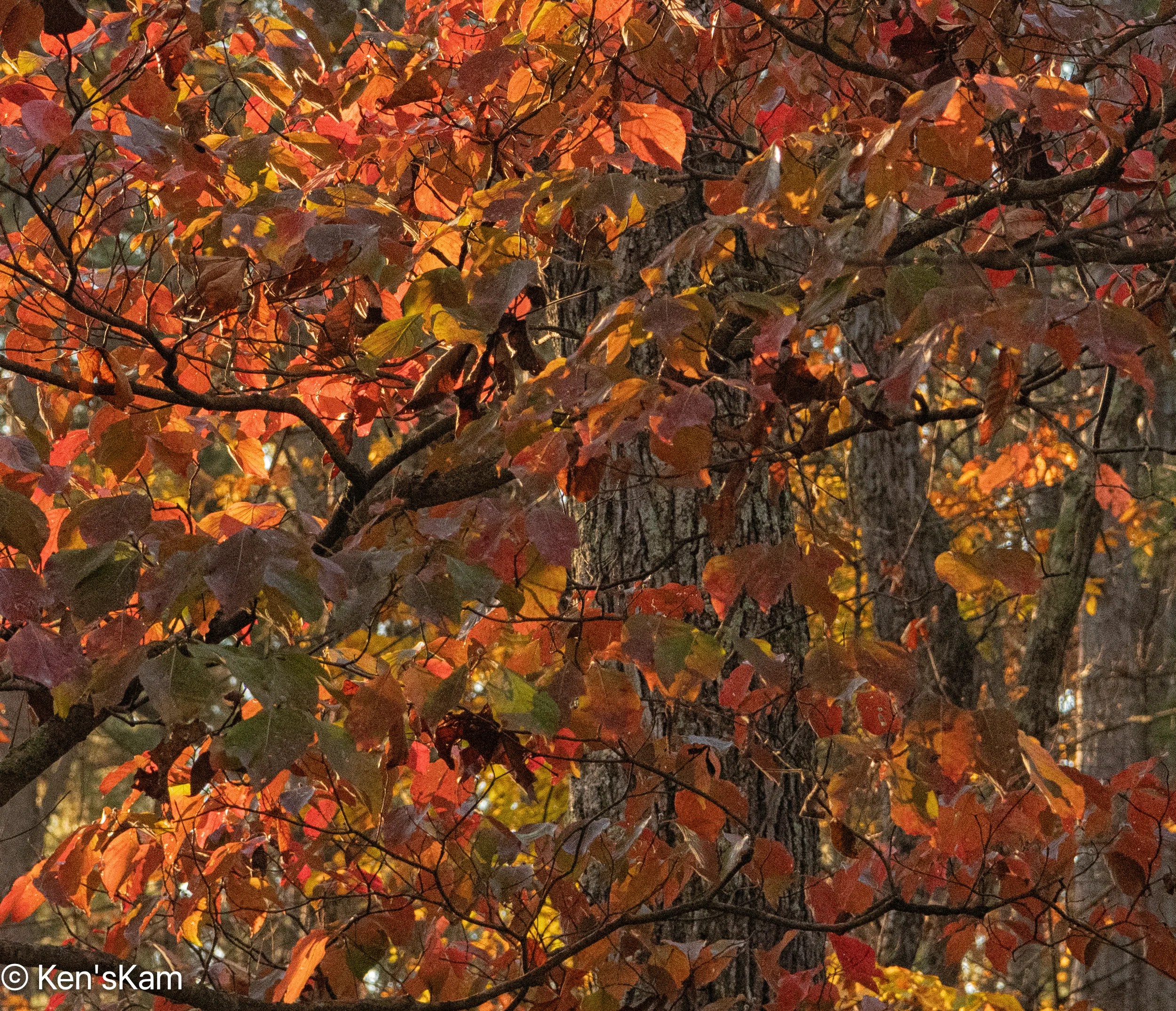
For these ICM (Intentional Camera Movement) abstract images in a forest, one can include the sky or exclude it. I find that I prefer those images with the sky limited or excluded, which usually requires cropping the image in post processing.
The direction of the light is also a factor in these image. Side light produces alternating light and dark patterns across the image, which I tend to prefer.
After a sunrise shoot at Tunnel View, I stopped at the parking area for Bridal Veil Falls. The falls can be seen from the parking lot and there is a short trail that gets one much nearer the falls. The trail is easy, but is slightly uphill most of the way, so it does take a little effort to hike.
I switched back to my 24-70mm lens before hiking the trail, but soon realized that the 80-400mm lens would have allowed me to capture close up images of details in the tall, slender waterfall.
The image above gives an idea of how far away the end of the trail viewing area is from the falls. This view covers the entirety of the falls from top to the bottom most part that I could see, including small portions in the bottom left, but excluding the sky to avoid exposure difficulties. I could have gotten a little closer, as a few people do, by climbing beyond the viewing area border, but I elected not to do so. One can easily see how a big lens would be useful for isolating smaller portions of this waterfall.
Bridal Veil Falls
This long, slender waterfall does not fall straight down, but swings back and forth across the rock face. Maybe with a heavier water flow it might fall in a more linear fashion, but this meandering path creates more interesting features and that “veil” appearance.
Bridal Veil Falls – Wide 2
This wider angle view gives a better indication of the local environment.
We woke up to a heavy snow cover in our campground the second morning of our visit here. We had been watching the weather forecast and expected snow over a large area, we just could not judge how much would fall at our location, which was a higher elevation than that used in the weather forecasts .
Snow in Bandelier Campground, March 2021, iPhone PhotoSnow in Bandelier Campground, March 2021, iPhone Photo
Judging by the depth of snow on the flat surfaces, it looks like 6-8 inches of cover.
After making a few early morning iPhone photos and taking care of a few housekeeping chores, I began to walk around the campground area with my DSLR.
I managed to isolate a few individual, snow covered trees against the overcast sky.
Snow covers Bandelier Campground, March 2021. Tree and Clouds 1.Snow covers Bandelier Campground, March 2021. Tree and Clouds 2.Snow covers Bandelier Campground, March 2021. Monochrome Tree and Snow.Snow covers Bandelier Campground, March 2021. Skeleton Tree in Snow.Snow covers Bandelier Campground, March 2021. Towering Tree in Snow.
As I walked around, I tried to capture a few small features in the snow covered landscape.
Snow covers Bandelier Campground, March 2021. Grass in Snow 1.Snow covers Bandelier Campground, March 2021. Grass in Snow, Monochrome.
And anything else that looked unique or interesting.
Snow covers Bandelier Campground, March 2021. Crawling Snow Covered Tree Creature.
A distant mountainside was visible through the forest and I tried to frame that in a few photographs, but the 24-70mm lens did not allow for close ups of the distant mountains tops.
Snow covers Bandelier Campground, March 2021. Distant Mountains 1.Snow covers Bandelier Campground, March 2021. Distant Mountains 2.
I think the individual trees are the best images that I captured here; but here are a few miscellaneous other images to give a feel for the general look of the snow covered forest area around the campground.
Snow covers Bandelier Campground, March 2021. Snow Forest 1.Snow covers Bandelier Campground, March 2021. Snow Forest 2.Snow covers Bandelier Campground, March 2021. Snow Forest 3.Snow covers Bandelier Campground, March 2021. Snow Forest 4.Snow covers Bandelier Campground, March 2021. Snow Forest 5.Snow covers Bandelier Campground, March 2021. Snow Forest 6.Snow covers Bandelier Campground, March 2021. Old and Fallen, Old and Standing.
It is good that I got out early to capture the snow, since it began to melt away even as I made my way back to my van. It was essentially all gone by late morning.
By the time this final post, covering my fall visit to the Rio Grande National Forest, is published it will be late spring of 2021. It would have been good to have been able to publish all of the fall photographs in the fall, but it takes time to review and edit so many photographs and there are always other trips, events and personal matters that delay getting posts prepared.
Maybe I should take fewer photographs? But photography of natural places is my hobby and I get to do too little of it as is, so I will continue to make as many photos like these as often as I can get away to do so.
Fall Forest. Nikon D850, Nikon 24-70mm @ 24mm, 1/320s, f/11, ISO 3200.Red and Green Leaf on Log. Nikon D850, Nikon 24-70mm @ 70mm, 1/200s, f/11, ISO 3200.
Dark Red. Nikon D850, Nikon 24-70mm @ 70mm, 1/200s, f/11, ISO 3200.Fall Forest Roadway. Nikon D850, Nikon 24-70mm @ 24mm, 1/500s, f/11, ISO 3200.Leaf on Log. Nikon D850, Nikon 24-70mm @ 70mm, 1/125s, f/11, ISO 3200.Leaves and Moss on Stump. Nikon D850, Nikon 24-70mm @ 24mm, 1/125s, f/11, ISO 3200.Leaves and Stump. Nikon D850, Nikon 24-70mm @ 70mm, 1/80s, f/11, ISO 3200.Trapped. Nikon D850, Nikon 24-70mm @ 70mm, 1/125s, f/11, ISO 6400.
I’ll finish with a final photograph that I think is appropriate for wrapping up this trip.
The heart shaped scar on this tree appears to be natural and not one of the many carved ones that I encountered.
As soon as I publish this, I will begin preparations for another trip to begin in a few days. I have much to do and still have to select a primary destination. Maybe by next year, I will even be posting photos from that trip. (I still have other events in the queue to work through before getting to anything new)!
Shelter. Nikon D850, Nikon 24-70mm @ 70mm, 1/100s, f/11, ISO 3200.Trunk Trio. Nikon D850, Nikon 24-70mm @ 52mm, 1/320s, f/11, ISO 3200.Hint of Fall, B&W with selective colorization. Nikon D850, Nikon 24-70mm @ 24mm, 1/320s, f/11, ISO 400.Sanctuary. Nikon D850, Nikon 24-70mm @ 70mm, 1/250s, f/11, ISO 2000.Forest Road and Barren Aspens, B&W with selective colorization. Nikon D850, Nikon 24-70mm @ 52mm, 1/320s, f/11, ISO 2000.Advanced Fall, B&W with selective colorization. Nikon D850, Nikon 24-70mm @ 24mm, 1/160s, f/11, ISO 2000.Advanced Fall. Nikon D850, Nikon 24-70mm @ 24mm, 1/160s, f/11, ISO 2000.Hanging On, B&W with selective colorization. Nikon D850, Nikon 24-70mm @ 24mm, 1/250s, f/11, ISO 2000.Stump with moss and leaves. Nikon D850, Nikon 24-70mm @ 32mm, 1/320s, f/11, ISO 3200.
Just one comment to wrap up this post. Viewers will note that I’ve include color versions of a few images that were then converted to black and white with selective colorization to add emphasis.
Stay tuned for the wrap up for my September 2020 Rio Grande National Forest visit.
For our late day shoot, we decided to drive back into a higher elevation portion of the forest. I’ll refrain from using too many words to wrap up the final shoot of my last day here, so these last several posts will consist of mostly photographs.
Aspen Fall. Nikon D850, Nikon 24-70mm @ 70mm, 1/250s, f/11, ISO 2500.Aspen Leaf and Evergreen. Nikon D850, Nikon 24-70mm @ 70mm, 1/200s, f/11, ISO 1600.Leaf and Bark. Nikon D850, Nikon 24-70mm @ 70mm, 1/80s, f/11, ISO 320.Fall Forest. Nikon D850, Nikon 24-70mm @ 24mm, 1/125s, f/11, ISO 1600.Leaf Hoard. Nikon D850, Nikon 24-70mm @ 70mm, 1/200s, f/11, ISO 2000.Leaf and Bough. Nikon D850, Nikon 24-70mm @ 70mm, 1/250s, f/11, ISO 2000.Golden Forest Floor. Nikon D850, Nikon 24-70mm @ 26mm, 1/250s, f/11, ISO 2000.Gnarly. Nikon D850, Nikon 24-70mm @ 32mm, 1/250s, f/11, ISO 2000.Soft Landing. Nikon D850, Nikon 24-70mm @ 70mm, 1/160s, f/11, ISO 3200.
The Aspen leaf in this photo had not quite completed its color transformation, before it fell to rest upon a mossy bed.
Yellow and Green, Nikon D850, Nikon 24-70mm @ 70mm, 1/1250s, f/11, ISO 5000.Aspen Leaves on Mossy Stump, Nikon D850, Nikon 24-70mm @ 70mm, 1/160s, f/11, ISO 3200.Forest floor, Nikon D850, Nikon 24-70mm @ 70mm, 1/200s, f/11, ISO 3200.
I prefer to photograph these little details as I find them; but sometimes I’m tempted to move things around. I did not move anything in the photo above; but I can’t help but wonder, if I should have. Should I have removed the blade of grass pointing at the Aspen leaf in the middle? Or does that blade of grass serve as a useful pointer in this photograph? Would this image be better, if I had cleared away some of the debris around the edges or the scattered leaves, leaving just the single leaf in the center? What about that little twig resting on the stump to the left of the center leaf?
I have no objection to “posing” a natural scene for artistic purpose and I have removed man made items from natural scenes and I’m quite ok with this. I’ve occasionally removed a twig, a fallen tree limb or a blade of grass, if I thought those were distracting in a scene. But nature is not perfect, so will “cleaning” a scene make it unreal? Is unreal ok in this sense? No one would know the scene has been modified, if not so informed by the photographer. Is it acceptable to “manufacture” a natural scene?
Red and Green, Nikon D850, Nikon 24-70mm @ 70mm, 1/250s, f/11, ISO 800.Aspen Leaf, Nikon D850, Nikon 24-70mm @ 65mm, 1/200s, f/11, ISO 800.
And I will wrap up this portion of this morning’s photos with one final forest image, which I just noted this morning was chosen for Flickr’s Explore page.
For landscape images it is best to make simple images with no distracting clutter. In a forest it is virtually impossible to avoid clutter. Trees and grasses grow in a mass of seeming disorder. Limbs and twigs stick out everywhere, the forest floor is covered with all kinds of natural debris, grasses and low growing plants, fallen trees and limbs. Still, I try to carefully consider what is in my composition. Sometimes I can exclude something that I consider particularly distracting, many times I just have to accept what is there and try to compose so that a viewer can get the intended message.
Star Burst Aspens. Nikon D850, Nikon 24-70mm @ 26mm, 1/200s, f/11, ISO 200.
Sometimes, isolating details, either via zooming in or cropping in post processing, works to eliminate clutter, but context may be lacking, if that matters.
Aspen Leaves. Nikon D850, Nikon 24-70mm @ 70mm, 1/100s, f/11, ISO 250Cradled. Nikon D850, Nikon 24-70mm @ 70mm, 1/80s, f/11, ISO 500.Forest Floor and Shadows. Nikon D850, Nikon 24-70mm @ 24mm, 1/100s, f/11, ISO 250.
The chaotic nature of a forest may be the message.